Tracking Your Period Is Not Enough. Here Is What Your Body Is Actually Telling You.
You have been marking dates on a calendar for years. But your body is saying so much more than when your next period is due. Most apps just are not listening.
The red dot on the calendar
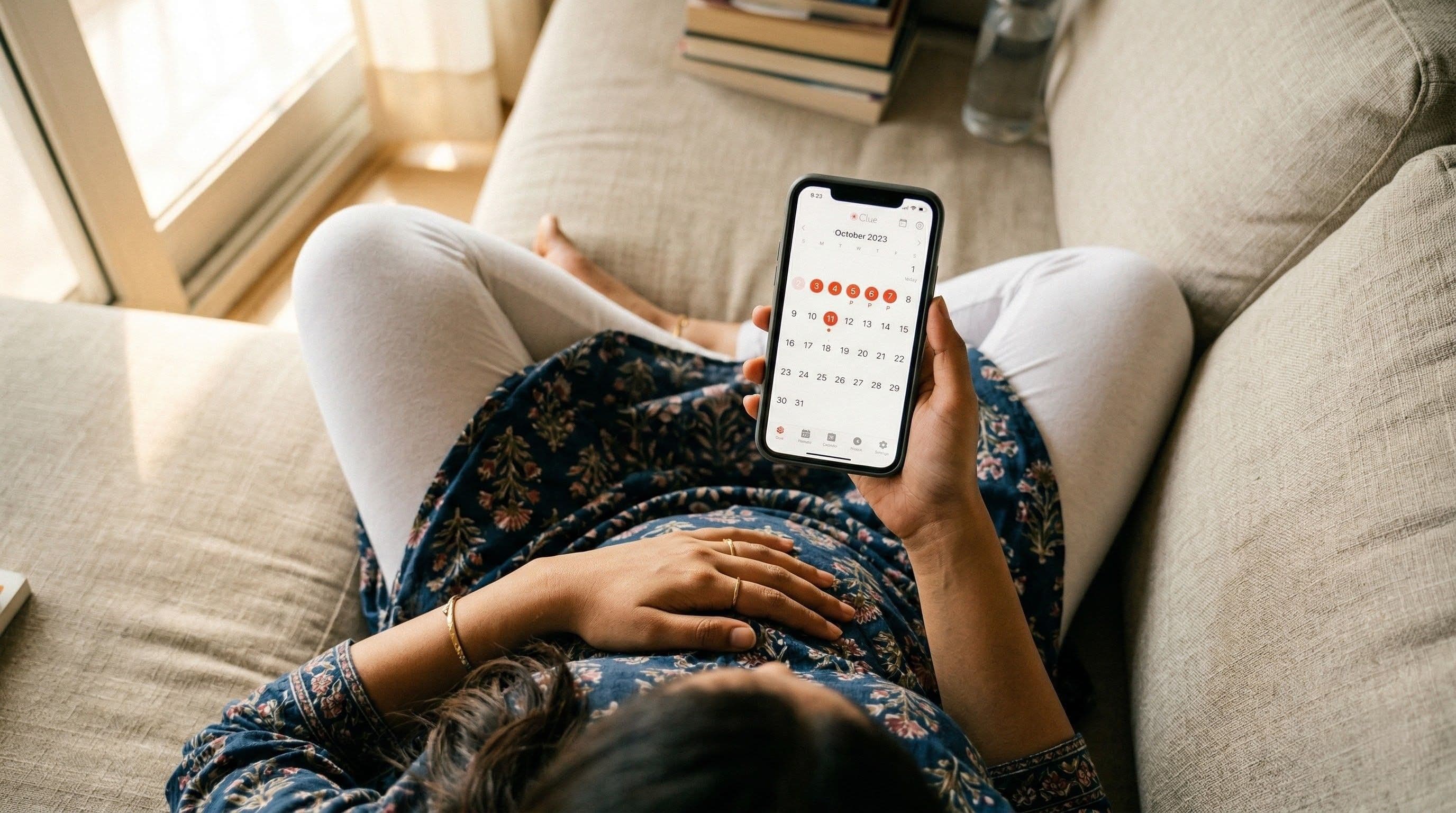
You have been doing this since you were 14 or 15. Marking the date. Counting the days. Maybe you moved from a paper calendar to an app at some point, but the core of it never changed.
Track when it starts. Track when it ends. Predict the next one. That is it.
And for years, that felt like enough. Because nobody told you there was more to pay attention to.
Your cycle is not just your period
Your period is 5 to 7 days. Your cycle is 25 to 35 days. And every single day of that cycle, your body is doing something different.
In the first half, estrogen is rising. Your energy is up. You feel sharper, lighter, more social. Your body handles carbs better. You recover from workouts faster.
In the second half, progesterone takes over. You slow down. You might feel more anxious, more tired, more hungry. Your body retains more water. Your sleep gets lighter.
None of this is random. It is a pattern that plays out every single month. And it affects your food, your mood, your energy, your skin, your digestion, your focus.
Your cycle is not a calendar event. It is the operating system your entire body runs on.
What period trackers miss
Most period trackers ask you one question: "Did your period start today?"
Some of the fancier ones let you log symptoms. Cramps. Headache. Mood. Bloating. You tap little icons, and the app stores them somewhere you never look at again.
But here is the thing: logging symptoms is not the same as understanding them.
You logged that you felt exhausted on day 22. And on day 23. And day 24. But the app never connected that to your cycle phase. Never told you this happens every month around the same time. Never suggested that this is when your body needs more iron, more rest, more patience with yourself.
It just stored the data. Like a filing cabinet that never reads its own files.
The patterns hiding in plain sight
If someone sat down and looked at your last six cycles together, they would probably find things like:
You get headaches around day 20. Every single month. Your cravings spike around day 18. Your sleep gets worse around day 23. You feel your best on days 8 through 12. Your digestion acts up in the luteal phase.
These are not random complaints. They are signals. Your body is telling you what it needs, when it needs it. But nobody is translating.
What understanding actually looks like
Imagine instead of just knowing "my period is due in 5 days," you knew: "This is the part of my cycle where my energy always dips. I usually crave more carbs right now. My sleep is going to be a bit off. And that is completely normal."
Imagine knowing that the anxiety you feel every month around day 21 is not you being weak. It is progesterone doing its thing. And it will pass in 4 days.
Imagine an app that said: "Your cycle suggests tomorrow might be a harder day. Maybe keep it light. Extra rest if you can. You always bounce back by day 3."
That is not tracking. That is understanding.
Your body has been talking this whole time
Swayu does not just ask when your period started. It listens to everything around it. Your food, your energy, your mood, your sleep. And over time, it starts connecting the dots that a calendar never could.
Not to overwhelm you with data. But to quietly say, at the right moment: "This is normal for you. Here is what might help."
Because your body has been trying to tell you things for years. It just needed something that was actually paying attention.